Blockchain integration in application modernization: Beyond cryptocurrencies
Blockchain technology has garnered significant attention in recent years, not just for its association with cryptocurrencies but also for its potential to revolutionize various industries. In the realm of software development, blockchain offers exciting opportunities to enhance security, transparency, and efficiency. In this blog post, we'll explore the benefits of integrating blockchain technology into software applications and how it can propel your organization towards greater innovation and success.
Understanding application modernization and blockchain
Let us first understand what application modernization and blockchain mean. Application modernization is essentially the process of revamping and enhancing existing software applications to align seamlessly with the demands of today’s business landscape. Legacy applications, though groundbreaking in their time, now grapple with a set of challenges. Outdated infrastructure, security vulnerabilities, and compatibility issues have become roadblocks hindering agility and stifling innovation. Consequently, actively exploring strategies for modernization to keep up with competitors is the need of the hour.
According to Foundry’s State of The CIO Study 2023, modernizing applications and infrastructures remains the third-highest initiative for Chief Information Officers (CIOs).
When we talk about the blockchain, it is more accurately a protocol that describes a specific way of packaging and structuring data in a ledger. So, in a blockchain, all the transactions written to the ledger are secured through cryptography. Over time, the transaction history gets locked into blocks of data that are cryptographically chained together and secured to make an immutable record of these transactions that is impossible to forge. When we have a decentralized ledger put into place, there’s no central authority controlling it. Rather, everyone who is part of the system shares and controls the information that is stored. So, what this means in practical terms is that if you’re participating in this network, you don’t need to trust a middleman to handle your transactions; you can transact directly with other participants in the network without needing to raise questions of trust.
The need for blockchain integration for application modernization
- Enhanced Security and Trust:
Traditional centralized systems are vulnerable to single points of failure and data breaches. Blockchain's decentralized architecture and cryptographic security mechanisms provide enhanced data security and integrity, fostering trust among stakeholders.
- Cost Reduction and Efficiency:
Blockchain integration can lead to significant cost savings by eliminating intermediaries, reducing transaction fees, and automating manual processes. By streamlining operations and enhancing efficiency, organizations can optimize resource utilization and improve their bottom line.
- Streamlined Processes:
Legacy systems often suffer from inefficiencies and manual interventions, leading to delays and errors. Blockchain integration enables the automation of processes through smart contracts, facilitating seamless and transparent transactions across distributed networks.
Use cases of blockchain integration in application modernization
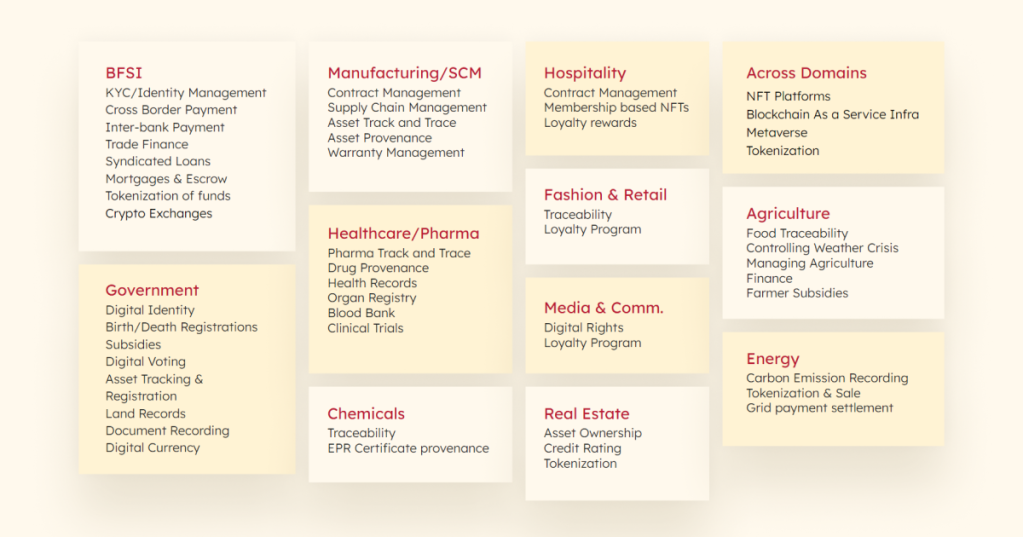
Here are a few of the ways businesses can leverage blockchain for app modernization:
- Smart contracts
Implementing smart contracts on the blockchain can automate and streamline various business processes, such as insurance claims, property transfers, and compliance tracking. It eliminates intermediaries, enabling businesses to modernize operations, reduce paperwork, and shorten processing time, thereby mitigating the risk of errors and delays.
- Healthcare:
Healthcare providers can leverage blockchain to store their patients’ medical records securely. When a medical record is generated and signed, it can be written into the blockchain, which provides patients with proof and confidence that the record cannot be changed. These personal health records could be encoded and stored on the blockchain with a private key.
- Supply chain:
Suppliers can use blockchain to record the origins of materials that they have purchased. IBM Food Trust is a good example where suppliers are using blockchain to record the origins of materials that they have purchased. This allows companies to verify the authenticity of not only their products but also common labels such as “Organic,” “Local,” and “Fair Trade.”
Conclusion
The transformative power of blockchain in application modernization is undeniable. From enhanced security to decentralized architectures and smart contracts, blockchain brings a myriad of advantages to the table.